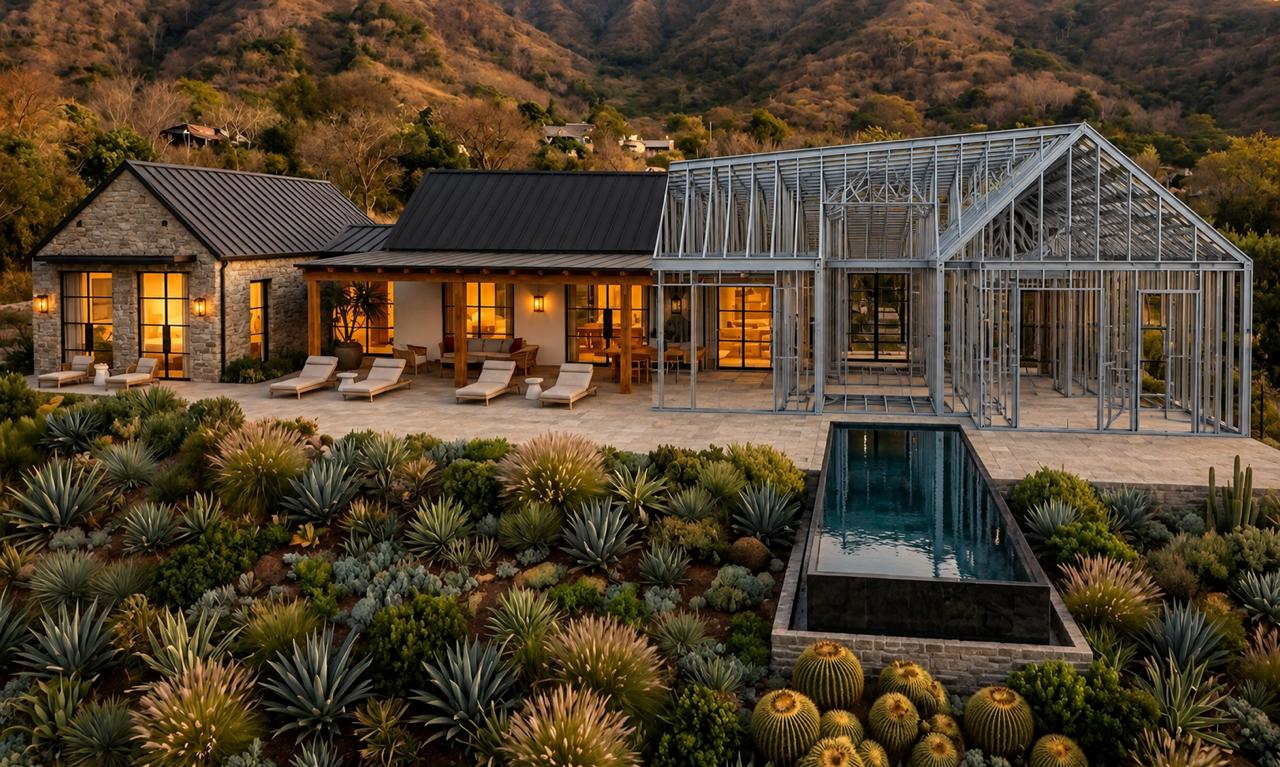
When we set out to build Mar Azul, we asked a simple question: Is there a way to construct homes that doesn't leave a trail of waste behind?
We weren't looking for greenwashing or marketing claims. We wanted something real — a building system that eliminated waste at the source, used materials that could be recycled at end of life, and didn't require thousands of gallons of water just to cure the structure.
That search led us around the world. And eventually, to New Zealand.
Born in New Zealand, Proven in Japan
In 1995, a company called Scottsdale Building Systems was founded in Napier, New Zealand. By 1997, they had launched something different: a fully integrated system that combined 3D building design software with CNC roll-forming machines that could produce steel framing components with perfect precision.
The concept was simple but radical. Instead of cutting materials on site and generating waste, every single component would be designed digitally and manufactured to exact specifications. The software and the fabrication machine spoke the same language — perfect hardware-software integration.
Today, Scottsdale Construction Systems remains the only company in the world that manufactures both the design software and the fabrication equipment. They acquired Knudson Manufacturing in 2023 and now operate across Australia, New Zealand, and North America.
"Some light gauge steel houses suffered no structural damage in the Great East Japan Earthquake — an event measuring intensity level 6." — Nippon Steel Technical Report
Why Earthquake Zones Trust This System
Japan has been using light gauge steel for low-rise housing since the 1990s. It's not experimental there — it's regulated, tested, and proven. The cold-formed galvanized steel, typically about 1mm thick, is designed specifically for seismic performance.
The secret isn't strength through rigidity. It's strength through flexibility. While traditional concrete fights against seismic forces, light gauge steel moves with them. The roof load is distributed across structural studs placed every 30-40 centimeters, spreading the stress across many connection points rather than concentrating it on a few.
New Zealand, another country that knows earthquakes intimately, has embraced the same technology. Canada too. These aren't countries that take construction risks. They use this system because it works.
How It Works
Every Mar Azul home begins as a 3D digital model. The Scottsdale software calculates every beam, every stud, every connection. Then it sends those specifications directly to the fabrication machine.
The machine produces each component to exact measurements. Not approximate. Exact. There's no cutting on site. No pile of offcuts at the end of the day. Every piece of steel that enters the workshop leaves as part of a home.
The pre-fabricated sections arrive at the site numbered and organized. Assembly is fast — the structure anchors to the foundation and the frame goes up in days, not weeks. And unlike concrete, there's no curing time. No daily watering for weeks on end. The structure is ready immediately.

The Ecological Reality
We've heard a lot of ecological claims from construction companies over the years. Most of them amount to planting a tree after cutting down a forest. We wanted something different.
Light gauge steel gave us that:
Recycled and recyclable. The steel itself comes from recycled materials. At end of life — decades from now — it can be fully recycled again. This isn't downcycling into lower-grade materials. It's true circular economy.
Zero waste. Because every element is cut to exact measurements in the workshop, there's no scrap. The construction site stays clean. Nothing goes to the landfill.
No water for curing. Concrete structures require weeks of daily watering to cure properly. In a region where water is precious, that matters. Light gauge steel requires none.
Better efficiency. The exterior walls allow for continuous insulation, making the homes behave almost like cooling rooms. In Costa Rica's climate, that means less air conditioning and lower energy consumption.
Natural Finishes, Minimal Maintenance
The structure is steel. But what you see and touch is natural.
For the exteriors, we use natural local stone, torched wood (the ancient Japanese technique of Shou Sugi Ban), and cement-based Venetian stucco. For the interiors, refined cement and Venetian stucco throughout.
These materials age beautifully. They don't need repainting every few years. They don't crack in the tropical humidity. They develop character over time instead of deteriorating.
The result is homes that look better at twenty years than they did at two.
We didn't invent this technology. We searched the world until we found it. A system born in New Zealand in 1995, proven in Japan's earthquakes, trusted in Canada's extremes — now building homes in Costa Rica that will stand for generations.
That's what responsible development looks like. Not claims. Results.